Book Blog

Blog

Immortal Beloved

By chance—that is, while browsing online and ruminating over regrets—I discovered that the partner of one of my college years’ two beloveds, long ago lost to death in the form of AIDS, had himself recently died, succumbing to equally dreadful Alzheimer’s. Though it seems like only yesterday, we had, a decade ago, briefly exchanged e-mails about the shared object of our affections after I, then also browsing and ruminating, had discovered a photograph he had posted of the angelic-looking young man for whom I had fallen so hard at the tender age of twenty-one. Now, a decade later, I find both of them dead.

Unsurprisingly, our messages recounted our memories of Robb and, less so, touched upon our being two of the few who remembered him. At the time, I never considered that, one day, only he or I would be left of the pair of us to remember. However, nine years later, I did have enough foresight to dedicate Dracula/Harker in part to Robb Caramico, who, as Narcis, had me, as Count Dracula, write of ephemeral earthly memory and God’s eternal memory:

Later that evening, after Mr. Harker and I had put the dirtied and bloodied chapel to rights, I put an end to the awkward silence between us by handing him a candle and saying, “Come with me. There is something I want you to see.” Then lighting the way with my own feeble flame, I led him down rough-hewn granite steps, through a rusted wrought-iron gate, and into the chill, airless murk of the crypt. There, under the main vault’s low, arched ceiling, standing amidst the clustered, moldering sarcophagi, their recumbent effigies, like the mortal remains lying beneath them, slowly crumbling to dust, I said, “This is death as you have doubtless never seen it. Look upon it and think on how close it came to you today.”

Ignorant and naïve as only the young can be, Mr. Harker replied, “I’ve seen death before and have since come to terms with my own.”

“That was the recent dead, the memories of whom will live on for years yet.” Swiping my hand overtop the closest stone coffin and holding up its gray-powdered palm, I continued, “These are the long dead, of whom almost everything is lost—so much so that they might as well have never lived, loved, or been loved. Only scribblings and inscriptions remain in remembrance of those you see here, which is more than can be said for the overwhelming number of their predecessors and peers who faded into oblivion long ago.”

Peering into the gloom, Mr. Harker asked, “Isn’t that what God’s eternal memory is for: to save us all from the earthly inevitability of being forgotten forever?”

“You mean the selfsame God who damned and drowned His creation and forsook His only begotten Son? It is no blasphemy to say even I care more about the living and the dead than He.”

“I see that,” the young man said, standing before the vault’s only alcove with his arm outstretched to cast his light over its single sarcophagus.

The Englishman again having me at a loss for words, I hoped my silence would somehow serve to deny the obvious.

Kneeling to better read the coffin’s inscription, Mr. Harker, reasoning aloud to himself as much as refuting my unspoken lie, argued, “No woman would lay a grave blanket of pine branches in June.” Then he straightened up, faced me, and asked “Who was Narcis?”

Exercising my utmost self-control, I answered, “From what survives of his memory, he was much like you.”

“But he died over four hundred years ago….”

“And the world should not suffer the loss of his like again.”
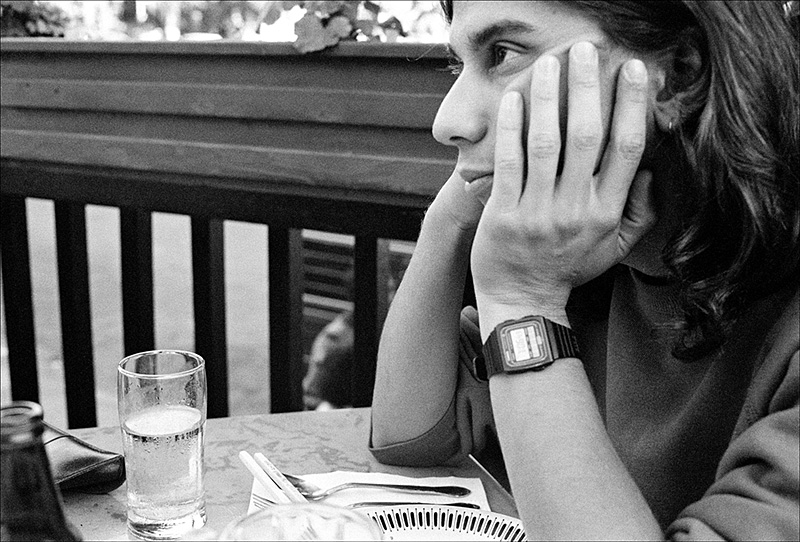
Robb Caramico, Berkeley, California, 1988. Photo by Walt Odets.

“Dracula/Harker—Part I” Short Video: “When the World Has Gone Mad”

Enter “modern woman” Wilhelmina “Mina” Murray in all her outspokenness and suspicion. Though she first appears in the first part of Dracula/Harker well before this diary entry, here is where she begins to marshal her formidable self-righteousness against the imposing foreigner Vladislaus, Count Dracula, in the cause of keeping hold of her fiancé Jonathan Harker, who has returned from Transylvania a different man.

“Dracula/Harker—Part I” Short Video: Arise!

The first anniversary of the publication of Dracula/Harker: A Gay Gothic Romance—Part I is upon us. I chose the month of June in 2025 because of Pride and because this first novella in the Dracula/Harker trilogy is about queer people overcoming prejudice, discrimination, and worse to take pride in their true natures and live for themselves and love as themselves, not as others say, preach, and legislate.

The year since has seen me learn hard lessons as a result of coming out publicly on the printed page, so to speak. (Part I is available only as an e-book.) But taking pride in my work, I have thickened my skin and carried on without hardening my heart, which I continue to pour out into Part II.

So, this Pride Month, I encourage queer folks who cannot be their true selves to do something—no matter how small—to celebrate themselves and to remember they are part of a global family that has always existed and will always exist.

And let all the LGBTQIA+ community never forget: No matter how many fires our persecutors set, we, like phoenixes, always arise!

Queer Dracula Online

When, to my disbelief and dismay, I discovered that the domain names QueerDracula.com and GayDracula.com lay disused, I immediately registered them and then decided to begin curating a list of online resources worthy of my newfound precious acquisitions. Having long entertained my own thoughts on gay Dracula and queer vampires in general, I am always intrigued by those of others. As one outcome of indulging my curiosity, I offer up below for your consideration what I have found to be particularly noteworthy in this continuously updated catalog.

Bram Stoker: His Internalized Homophobia Externalized in “The Censorship of Fiction”

Whereas twenty-four-year-old Bram Stoker’s 1872 letter to Walt Whitman confessed his yearning for comradeship with like-minded unconventional men, and forty-nine-year-old Stoker’s 1897 publication of Dracula, with its dueling depictions of comradely and predatory male interactions, revealed the author’s anxiety over Oscar Wilde’s 1895 trials and imprisonment for “gross indecency,” sixty-year-old Stoker’s article “The Censorship of Fiction” (1908) amounted to a public declaration of his internalized homophobia. Though couched in opaque Edwardian language, his self-loathing turned outward and against other authors indisputably targets, among other so-called unspeakable unnatural depravities, homosexuality as depicted in fiction, as spelled out in boldface at the end of the following passage:

“The self-restraint and reticence which many writers have through the centuries exercised in behalf of an art which they loved and honoured [i.e., fiction writing] has not of late been exercised by the few who seek to make money and achieve notoriety through base means. There is no denying the fact nor the cause; both are only too painfully apparent. Within a couple of years past quite a number of novels have been published in England that would be a disgrace to any country even less civilized than our own. The class of works to which I allude are meant by both authors and publishers to bring to the winning of commercial success the forces of inherent evil in man…. For look what those people have done. They found an art wholesome, they made it morbid; they found it pure, they left it sullied. Up to this time it was free—the freest thing in the land; they so treated it, they so abused the powers allowed them and their own opportunities, that continued freedom becomes dangerous, even impossible. They in their selfish greed tried to deprave where others had striven to elevate. In the language of the pulpit, they have “crucified Christ afresh.” The merest glance at some of their work will justify any harshness of judgment; the roughest synopsis will horrify…. It may be taken that such works as are here spoken of deal not merely with natural misdoing based on human weakness, frailty, or passions of the senses, but with vices so flagitious [i.e., atrociously wicked; vicious; outrageous], so opposed to even the decencies of nature in its crudest and lowest forms, that the poignancy of moral disgust is lost in horror. This article is no mere protest against academic faults or breaches of good taste. It is a deliberate indictment of a class of literature so vile that it is actually corrupting the nation.”

It is beyond belief that Stoker did not comprehend how his own words could be used against his own work (i.e., Dracula) to argue it “deeply affect[ed] the principles and lives of the young people of [his] country” and called for “repressive measures such as are required in dealing with all crimes”—including the intervention of “the police.” But then, he doubtless believed his own published depravity was worthy as a cautionary tale against the sins he excoriated and, like most hypocrites, entertained, even if he could not bring himself to enjoy them.

Gay Dracula’s Closeted Author Bram Stoker

In a letter that apologizes for itself at length, twenty-four-year-old Bram Stoker wrote to fifty-two-year-old Walt Whitman in February 1872:

  • “If I were before your face I would like to shake hands with you for I feel that I would like you—I would like to call you Comrade and to talk to you as men who are not poets do not often talk. I think that at first I would be ashamed for a man cannot in a moment break the habit of comparative reticence that has become a second nature to him; but I know I would not be long ashamed to be natural before you. You are a true man and I would like to be one myself and so I would feel towards you as a brother and as a pupil to his master. In this age no man becomes worthy of the name without an effort. You have shaken off the shackles and your wings are free. I have the shackles on my shoulders still.—but I have no wings. If you are going to read this letter any further I should tell you that I am not prepared to “give up all else” so far as words go. The only thing I am prepared to give up is prejudice—and before I knew you I had begun to throw overboard my cargo—but it is not all gone yet.”
  • “You see I have called you by your name I have been more candid with you—have said more about myself to you than I have ever said to any one before—You will not be angry with me now if you have read so far you will not laugh at me for writing thus to you. It was with no small effort that I began to write and I feel reluctant to stop, but I must not tire you any more. If you ever would care to have more you can imagine, for you have a great heart, how much pleasure it would be to me to write more to you, how sweet a thing it is for a strong healthy man with a woman’s eyes and a child’s wishes to feel that he can speak so to a man who can be if he wishes father and brother and wife to his soul. I don’t think you will laugh Walt Whitman, nor despise me, but at all events I thank you for all the love and sympathy you have given me in common with my kind.”

These soulful sentiments, penned almost twenty years before Stoker started drafting Dracula, inform its most homoerotic passage, in which Dracula rages at his so-called brides regarding Jonathan Harker:

“‘How dare you touch him, any of you? How dare you cast eyes on him when I had forbidden it? Back, I tell you all! This man belongs to me! Beware how you meddle with him, or you’ll have to deal with me.’”

That Stoker’s coded language in his letter arose from his reading of William Michael Rossetti’s prudishly abridged Poems of Walt Whitman is remarkable. That it gives way to free expression in his most famous work of fiction is undeniable.

“Dracula/Harker—Part I” Short Video: “I Awoke Alone”

In the second chapter of the first part of Dracula/Harker: A Gay Gothic Romance, Jonathan Harker awakens in the middle of the afternoon—naked but for a few bandages—in secluded, desolate Castle Dracula, unable to recall much of what transpired between him and the mysterious Count after his arrival at the Borgo Pass the night before. Why Jonathan cannot remember and what he cannot remember form the basis of the plot of this first novella in the trilogy.

‘Dracula/Harker’ and “Dracula’s Guest”

Dracula/Harker: A Gay Gothic Romance owes much to Bram Stoker’s posthumously published short story “Dracula’s Guest.” Possibly a rejected early draft from or an excised first chapter of Dracula, this less-renowned work is nevertheless notable in the context of my novella series for two reasons. First, it depicts Count Dracula as proactively protective of a presumed Jonathan Harker in that the Transylvanian nobleman is shown shadowing the Englishman in Munich and, upon his being imperiled by both nature and the unnatural, anonymously and supernaturally interceding on his behalf. Second, “Dracula’s Guest” introduces the character of the “Countess Dolingen of Gratz in Styria, [who] sought and found death [in] 1801,” “a beautiful woman, with rounded cheeks and red lips, seemingly sleeping on a bier” inside “a great massive tomb of marble” assumedly almost a century after her suicide. Though limited to these two influences, the import of “Dracula’s Guest” to Dracula/Harker is significant. For how it inspired my work as well as for its own unique merits, I encourage you to read or re-read this lesser-known piece of the Dracula mythos.

Something went wrong. Please refresh the page and/or try again.